
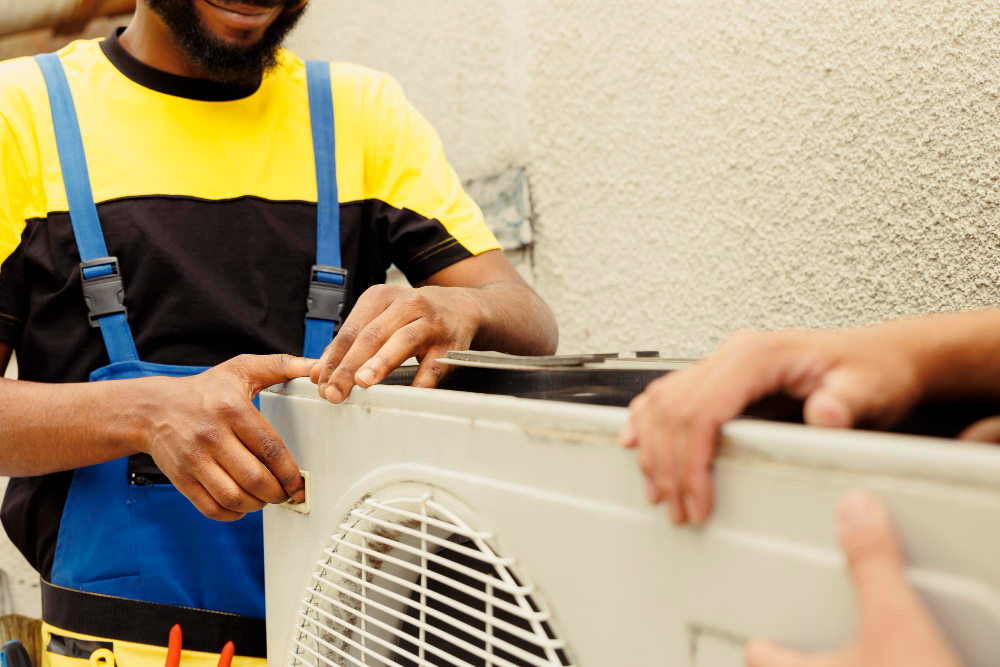
It is 112 outside, the AC has not shut off since mid-morning, and someone suggests turning it off for a couple of hours to let it rest.
It sounds reasonable. It is also the most common piece of bad advice about air conditioning, and following it usually makes the afternoon worse.
The short answer: no, and switching it off tends to backfire
Residential air conditioners are built for continuous duty. In a properly maintained system, compressors, fans, and motors are designed to run for hours without pause, and long runtime alone does no damage.
The pattern that causes wear is the opposite one. Short cycling, where the system starts and stops repeatedly, is hard on a compressor because the highest electrical load happens at startup. A unit running steadily is under less stress than one starting six times an hour.
Why it never shuts off on the hottest days
Cooling systems are sized against a design temperature, a figure representing the hot end of what a location normally sees, not the worst day on record. A system sized for the absolute extreme would be oversized, short cycling for most of the year and dehumidifying poorly.
Past that design point, the math changes. Heat enters the house faster than the system removes it, so the equipment runs at full duty and the indoor temperature drifts a few degrees above setpoint. That is expected at the top of the range, not a malfunction.
Where it stops being normal is when the gap keeps widening or the house never recovers after sundown. At that point, something else is going on, and it is worth having an AC repair technician read the pressures rather than waiting it out.
Your system gets weaker as it gets hotter
An air conditioner does not create cold air. It moves heat from inside the house to the outside, releasing that heat through the outdoor coil into the surrounding air.
At 95 degrees, the outdoor coil can shed heat relatively easily. At 112 degrees, the temperature difference it works against is much smaller; system pressure can climb, and cooling capacity can drop. The equipment delivers less cooling at exactly the moment the house demands more.
If extreme temperatures expose an underlying equipment problem, professional heating repair services can help identify issues with the system and determine whether maintenance or repairs are needed to restore reliable performance.
What happens if you switch it off for a few hours
Everything solid in the house absorbs heat: framing, drywall, tile, furniture, the slab. In a shutdown, the indoor air warms first, then all of that mass warms behind it.
Restart in the late afternoon and the system has to pull heat from the air and the structure at once, during the hottest hours, with capacity already reduced. Recovery takes hours, the equipment runs flat out throughout, and the energy saved is generally given back with interest.
A setback of a few degrees while nobody is home is reasonable. A full shutdown on a 110-degree day is not.
What extreme heat actually strains
Long runtimes do not break equipment. Heat plus a pre-existing weakness does, and these parts give out first in a Las Vegas summer.
- Capacitors. Heat shortens their life, and a failing one leaves the compressor or fan motor unable to start. This is one of the most common midsummer failures.
- Contactors. The switch that energizes the outdoor unit pits and burns over thousands of cycles, and heat accelerates it.
- Dirty outdoor coils. Dust and cottonwood block airflow through the condenser, which raises operating pressure and can trip the system on a safety.
- Low refrigerant charge. A slow leak that went unnoticed in April becomes obvious in July, sometimes as ice forming on the indoor coil or the line set.
- Restricted airflow. A clogged filter starves the system, cutting capacity and risking a frozen coil.
All of that is catchable in advance. A pre-season HVAC companies visit tests capacitors under load, checks the contactor, cleans the outdoor coil, and verifies charge. That is why systems on a plan fail less often in August.
Working hard, or in real trouble?
Normal on a very hot day: the system runs continuously, the indoor temperature sits two or three degrees above setpoint through the afternoon, and the house catches up in the evening.
Not normal at any outdoor temperature: vent air close to room temperature, ice on the refrigerant lines or indoor coil, a breaker that trips repeatedly, a grinding or hard clicking noise at startup, or an indoor temperature that climbs hour after hour instead of holding.
Any of those needs eyes on it, and Infinity answers air conditioning calls around the clock, because a failure at 4 pm in July is not something that waits comfortably until Monday.
What actually helps during a heat wave
Leave the thermostat at one setting instead of chasing it. Close blinds on west-facing windows before the afternoon sun arrives. Change the filter monthly through summer, since Las Vegas dust loads filters faster than the packaging suggests. Run ceiling fans in occupied rooms only, since fans cool people and do nothing for an empty room.
If one bedroom or a converted garage never keeps up no matter what the rest of the house does, that is usually a distribution problem rather than an equipment problem. A ductless mini-split handles those spaces without re-engineering the whole system.
Frequently asked questions
Is it bad for my AC to run 24 hours straight?
No, provided it is cooling properly. Continuous operation is what these systems are designed for, and it is easier on a compressor than repeated starts.
Should I turn the AC off when I leave for work?
Set it back a few degrees instead of shutting it off. A deep setback in extreme heat means the system may not recover before evening, and it runs at full output for hours trying.
Why is my house 78 when the thermostat is set to 74?
On an extreme day this usually means the outdoor temperature has passed what the system was sized for, and capacity has dropped at the same time.
There is ice on my AC in 110-degree heat. How?
Ice almost always means low refrigerant charge or restricted airflow, both of which drop coil temperature below freezing. Switch to fan-only to thaw it and call for service.
Would a bigger system solve this?
Rarely, and oversizing brings its own problems, including short cycling and poor humidity control. If your equipment is more than a decade old or struggling every summer, the useful conversation is about efficiency and correct sizing.
Conclusion
An air conditioner running all day in a Las Vegas summer is doing what it was built to do. It does not need rest, and a break costs you comfort and energy without protecting anything.
What genuinely protects it is a clean coil, a healthy capacitor, correct charge, and a clear filter, all of which get checked in a seasonal tune-up. Infinity is a Trane Comfort Specialist with NATE-certified technicians serving the Las Vegas Valley, and current seasonal specials include a tune-up at a set price.
Call (702) 291-2000 or schedule an appointment online, and you will reach a real member of our team rather than an answering service.
